Interventions
See which attempts were stopped — and why.
Select an intervention to see its reason and outcome. Completed tasks stay alongside it, so a blocked attempt is not confused with finished work.
Your agent stops being a new hire every morning. Before Claude Code or Codex edit a file, Kaplira hands them its history: what was decided, what was removed on purpose and what broke before.
On this site, a new agent planned a seventh section. Kaplira handed it the August decision to keep six. It stopped and asked. See what happened
Free desktop app. No account required.
Run interventions4 of 25

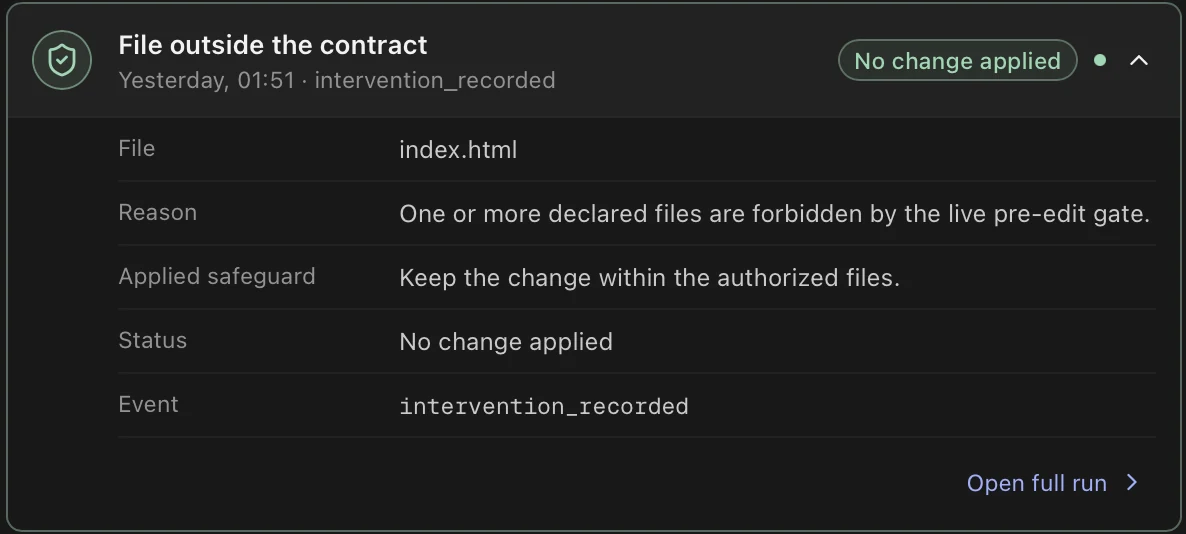
You weren’t watching. The agent reached for a file outside the task, and nothing changed.


A recorded intervention
Kaplira asks the agent to acknowledge what it delivers; it doesn’t prevent the edit. Read the boundaries.
Inspect the evidence model →Evidence cockpit
Inspect the run, its evidence, and what stays with the project.
Interventions
Select an intervention to see its reason and outcome. Completed tasks stay alongside it, so a blocked attempt is not confused with finished work.
Run detail
Open a completed task to inspect its execution steps, changed files, impact, and interventions.
Run receipt
A completed run records the change, interventions, preserved evidence, files, and validation state instead of leaving proof scattered through chat history.
Files with diff
Each completed run opens into the files it touched and the actual diff behind the claim, without leaving the changes ledger.
Construction memory
Decisions, unresolved risks, and active protections stay attached to the files they concern, so the next run starts from them — whichever agent or model takes it.
FAQ & trust
Straight answers on how Kaplira handles context, data, and agent autonomy.
Keep them — Kaplira works alongside your notes. What a notes file can’t do is know which files a rule applies to, check an edit against it, or record what actually changed. Kaplira keeps accepted decisions and known errors with the project, linked to the files they affect. On a governed task, the agent gets the ones that task touches, planned edits are checked against the task’s scope when a pre-edit gate applies, and a receipt records what changed — so the next task starts from it.
Independent by design
Kaplira is created independently by Vando Pereira, a software engineer building the product end to end.
The mission is simple: make AI-assisted software development faster without making software systems harder to understand, govern, or trust.
Read about KapliraFounding beta
Download the free desktop app and use it without signing up.
Want to help shape Kaplira? Share feedback directly with the founder. Start small: